

From concept to creation, most of my short stories take me anywhere from a handful of hours, such as in Parallel Earth Transport Service, which was the writing equivalent of improv, to the forty plus hours of work that I put into Haven Lost: Eternal Vigilance. Each story follows its own formula but for the most part I have a set of steps that I follow to create my stories. Today, I’m going to share the process that went into my latest story.
Step One: Concept
Step one is coming up with the concept. In my case, I have two main tools that I use for conceptualizing short stories and novels: my notebook and my whiteboard. I keep a notebook on or near me at all times just in case something inspires an idea. If I have a particularly vivid dream, I jot the details that I can remember when I wake up. Should a song trigger an idea, in the notebook that idea goes. When I get the time, I go back into the notebook and try to elaborate or flesh out the idea, at least enough to get a basic plot going.
From there, the ideas that I either enjoy the most of have the most potential to become a story go onto the whiteboard. At any given time I typically have between four and five short story ideas on the white board. I keep this whiteboard on the wall next to my work station and on it is my entire writing schedule, including deadlines for contests, top priority work for my novel, a general To-do list, blog ideas, proofreading projects, and my short story ideas. Essentially the white board is my entire writing career cooked into one spot. Once something makes it onto the board, it is scheduled and eventually executed.
Step Two: Outlining
Outlining is something of a contended point in the writing community. Some authors, such as the great Stephen King think very little of outlines.
“Outlines are the last resource of bad fiction writers who wish to God they were writing masters’ theses.”
Stephen King
Others, such as Ernest Hemingway, think outlining is an essential part of the writing process.
“Prose is architecture. It’s not interior design.”
Ernest Hemingway
Both are absolutely correct in their views and in my opinion you need take a little of both in writing a story. Before I outline, I usually have the entire story in my head. I could go straight to my computer and type out the story and maybe it comes out alright. On the other hand, it could also come out a complete disaster as well. This is where outlining comes in handy.
With Eternal Vigilance (spoilers ahead), I knew what the story looked like in my mind. From minute one, the Vigilant was going to be attacked by three ships, killing the captain and leaving my protagonist, Grey Dynast, in command. Through a combination of planning and skill, the Vigilant would overcome the three ships and survive the ambush.
What I didn’t know was how any of this happened and this is where the outlining came in handy. I had two words that I wanted to live by while writing this space battle: Clever and believable. This creed shaped the way that I wrote all the engagements in the story. I broke the story down into three parts; The initial ambush, the first sortie, and the final sortie. From there I wrote a basic idea of how the Vigilant could emerge victorious in each of these scenes.
Part Three: Research
This is arguably the most time consuming part of the story for me. When I write, it is important that my reader’s shouldn’t have to to suspend their belief any further than necessary. I want the reader to look at my stories and say to themselves that what I am writing, while not possible, is at least feasible.
For writing space combat, it was important to me that this was combat that operated within the realms of Newton’s universe. That means physics were a part of the equation from the very first word. This meant that the way the ships were designed, the way the ships moved, and the way the ships fought, would have to be at least feasible in our universe.
The first step was designing the Vigilant. One of the biggest issues with star ships in most entertainment is how they are designed. Star Trek and Star Wars rely on artificial gravity for their spaceships, allowing them to be designed horizontally, similar to modern naval vessels. These ships would be crippled without artificial gravity as their boosters are all on the rear of the vessel and the second they began to accelerate, everything inside would be thrown towards the back of the vessel.
Law I: Every body persists in its state of being at rest or of moving uniformly straight forward, except insofar as it is compelled to change its state by force impressed.
Law II: The alteration of motion is ever proportional to the motive force impress’d; and is made in the direction of the right line in which that force is impress’d.
Law III: To every action there is always opposed an equal reaction: or the mutual actions of two bodies upon each other are always equal, and directed to contrary parts.
Newton’s Laws of Motion
For Eternal Vigilance I opted to go the route of being fully reliant on Newtonian physics for their motion. This meant that if the ship was designed more akin to high-rise building with a rocket booster on the bottom. When the ship wasn’t accelerating or decelerating, the crew inside would be operating at near weightlessness. When the ship accelerated or decelerated, always from that bottom booster, it would simulate gravity due to laws of inertia. So if the ship was accelerating constantly at 9.87 m/s, it would essentially feel as if there was gravity equivalent to Earth on the ship. Keep in mind that there is a difference between acceleration and velocity. Velocity is how fast something is moving while acceleration is the rate at which velocity is changing. The easiest example for most people is to compare it to driving; when you are speeding up you feel as if you are pressed into the back of your seat. When you are slowing down, you feel as if you are being pulled towards the front of your car. When your car is moving a constant speed, you don’t feel either of those. Not the easiest concept to understand but a vital one for understanding space travel with Newtonian physics. For a great example of media that understands this, James S.A. Corey’s The Expanse books and television show do a great job of illustrating space ships in a Newtonian context.
The Vigilant was designed to operate in a Newtonian universe. The very first scene, when the ship is at rest, I made the point of showing that there was no gravity on the ship. The first time they accelerated, I made it a point to show that the acceleration and the inertial force had an effect on the people on board. I wanted it to be clear from the start that this was going to be a ship that could feasibly exist.
Next step was actually designing a futuristic military vessel. I knew that the Vigilant would be long with its main engine on one end and the various decks laid out like multiple stories of a building. I went so far as to draw up an excel spreadsheet with a two-dimensional cross section of the ship.
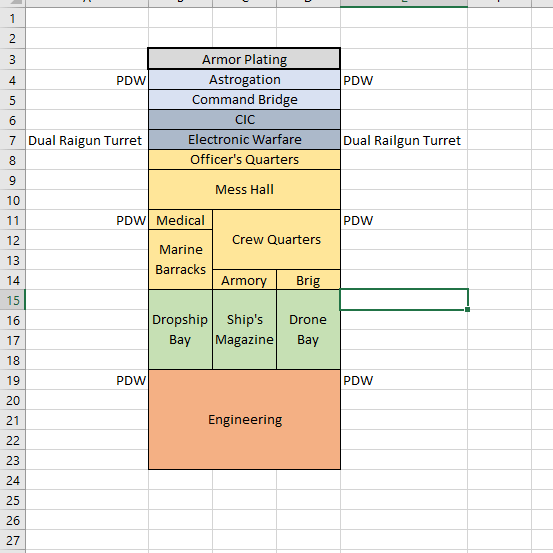
From the diagram you can get the basic idea of the layout of the Vigilant, and in turn most of the ships in the story. Thick armor playing on the bow of the ship followed by the Command, then living quarters, the hangar, and lastly Engineering in the bowels of the ship. When accelerating, of conversely flipping and decelerating, the inertial force would make it feel as if the ship was a building, with Engineering being on the ground floor and the Bridge being the top floor, with transit in between floors done by elevator or ladders.
With the ship designed in a way that would function in our universe, I started thinking about the actual combat. It wouldn’t be like Star Wars, which has more in common with World War II fighter planes than actual space combat. I kept a few tenets in mind for the combat and how the ship design would effect that. First tenet was that space combat takes place in three dimensions and covers an absolute mind-blowing amount of distance. I’m talking tens of thousands of kilometres at times. The second tenet was to keep in mind the size of these ships. The Vigilant is about one hundred meters from stern to bow. The dreadnought that they fight in the end of the story is almost five hundred meters in length and fifty in diameter. As the ship gets larger, it becomes less maneuverable due to the amount of energy required. So, the destroyers, at about seventy meters in length were more maneuverable than the Vigilant, but the Vigilant was far more maneuverable than the dreadnought. The final tenet was that these ships would want to present the smallest target possible. This meant that combat would likely be a lot of bow to bow while the ships used thrusters (small jets on the hull) to maneuver. These are not navy ships using broadside tactics; these are space craft designed to operate in the vastness of space and should have their own tactics. Much of the combat was designed around which ship could maneuver in such a way that they could line up their weapons with the other ships flanks. These ships were armored to reflect that philosophy as well with the bows being heavily armored than the rest of the hull.
With all this in mind, the Vigilant was shaping up to be a roughly twenty story tall building with a thick plate of armor on top and a huge engine on the bottom. Next step would be weaponry. What sort of weapons would they strap to these warships in the future. Probably not lasers, as the further away something is the less focused a laser would be. Might work well in close combat but would be useless at long ranges. Explosive weapons don’t work well in the vacuum of space as there is not oxygen to carry the shock-waves, so those were out. I looked to the influence of a few of my favorite hard science fiction sources.
First was Knights of Sidonia, a manga and Netflix show. The majority of their weapons were kinetic, such as machine guns and the mass driver, which essentially is just a cannon that launches a massive piece of metal at speeds nearing the speed of light. The mass driver was used twice in the series to just straight up destroy planets that the enemy aliens were using as bases and the kinetic weapons on the Gardes, the mecha in the ship, meant the pilots had to take into account the recoil from the projectile and the weight of their Garde as it expended ammunition. There was a weight to the impact that these weapons had, partially due to the immense speeds that they were travelling at.
Second, I looked once again to The Expanse. Quite frankly, James S.A. Corey just does realistic combat better than everyone else. Magnetically charged railguns operate on a similar idea to the mass drivers from Sidonia and the multipurpose Point Defense Cannons act as both defensive countermeasures as well as close combat weapons. For all the long range combat, missiles with advanced guidance systems were effective. Corey keeps it simple and believable, which is important.
Lastly, I tried to think outside the box a bit. This is where I looked to Scott Westerfield’s Succession series. The weapons in those books were amongst the best in science fiction, from blasts of radiation to a cloud of sand moving at almost light speed, the weapons were as creative as they were destructive. The biggest take away from his books was the drones. As awesome as star fighters are, the constant changes in acceleration would leave a human pilot as little more than a puddle of goo in reality. Instead, drones were used as strike craft to keep the pilots safely inside the main ship without subjecting them to the rigors of a high g accelerations.
In the end, it came down to modern kinetic weapons, designed for both long range and close, with an emphasis on drones as strike craft. Things were starting to shape up and The Vigilant was taking form. The only thing left was to figure out what sort of crew the ship would require to operate the vessel.
This is where I turned to our closest approximate, Naval vessels. I looked at command structures and designed multiple departments for the ship; such as command, tactical, astrogation, drones, communication, and engineering. I modeled the numbers needed to crew one of these ships off of their naval equivalent. For example, the Vigilant had a crew of about a hundred, broken down between the various departments.
With the ship designed with rules in place, it became time to focus on setting. This is where space combat proves problematically boring: Space is huge and empty. Realistically ships would be engaging each other from tens of thousands of kilometres using missiles. This unfortunately makes for a very boring story as the ships would rarely be close enough to truly engage in any close quarters combat. At best the ships would have a split second fly by at extreme speeds in which they unleash a volley of weapons, then circle around to do it again. Space combat would be jousting, except done at incredible speeds and at the beginning of each round you would launch a bunch of semi-intelligent missiles at your opponent.
This required a unique solution, which in this case was The Sepulcher. I knew that I wanted to force the ships into close quarters combat and to have the environment play a role in the battle. One of my favorite film scenes of all time is the asteroid belt scene from The Empire Strikes Back. As awesome as this scene is, it also completely misrepresents what an asteroid belt truly looks like. In truth, the asteroids in our own asteroid belt are upwards of half a million miles apart each.
The closest thing we have to an asteroid field like that seen above is in the planetary rings. However, the problem with the rings is that while they may be dense enough, none of the rocks in a ring would be big enough for a ship to hide behind and the rings just aren’t that thick. Saturn’s rings are only about ten meters thick for example.
My solution was to essentially bend the rules a little bit for the sake of story. The Sepulcher is the remains of a planet destroyed by an advanced alien species roughly seven to eight hundred years before the events of Eternal Vigilance. This is touched upon in the novel, but not in the short story. What this allowed me to do was create a scenario in which I could have a field of densely packed large asteroids that hasn’t either spread out into a massive belt around the system or re-coalesced into a new planet. More importantly, it gave me a setting where the ships would be forced to engage at close distances as opposed to thousands upon thousands of miles away.
With the ships and the settings researched and established, the remaining research essentially came down to time and distance. I made sure that travel times were correct using a space travel calculator. From my notes for Haven Lost, I knew what the date of this attack was so from there I figured out where in their respective orbits all three planetary bodies were (Dusk, Dawn, and The Sepulcher) which allowed me to figure out the distances between them at that time of year.
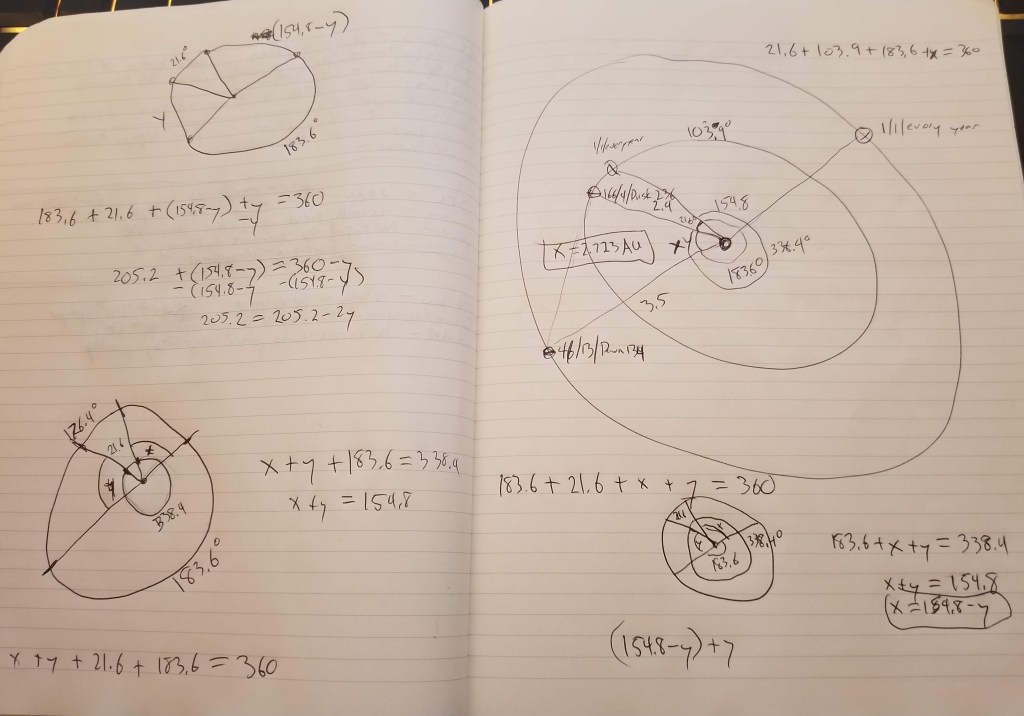
Essentially I wanted to make sure that any number that I put in this story, be it for a passage of time or distance, was as scientifically accurate as possible. It is important to me as an author that my works hold up to scrutiny in order to limit that suspension of disbelief. As much as I love the science fiction of old, the scientific accuracy of modern sci-fi has set a very high bar.
Part Four: The Drafting Process
While research may be the most time consuming part of the process, drafting is the most work intensive portion of the whole thing. This is where I take my concept and outline and research, and start putting it into words. At this point I typically turn on some music (for this story I listened to Secession Studios & Greg Dombrowski while I was drafting) and I start typing.
There’s no real other way to describe this portion except sitting at the computer and trying to tell the story with your words. Sometimes it flows and I’ll get ten thousand words out no problem, other time I’ll be stuck on a single paragraph for hours. I always keep thesaurus.com open while I’m writing for those moments where I feel like I may have used a word too many times or just need a better word. The key to the first draft is to simply get it done. The first draft of Eternal Vigilance took me roughly eight hours to finish.
It is also important to note that the first draft should not ever be your final draft. On average I usually have three drafts for my short stories. The first is typically riddled with spelling and grammatical errors, the second usually has some major plot point issues, and the third is where I focus in on character behaviors and motivations. It is important to me that character’s behaviors are consistent throughout, albeit with room for change and growth.
Conclusion: The Final Product
The point of this post was to give you an idea of what goes into writing one of these stories. I love writing and even if I was the only one who read my stories I would still keep on writing. I put a ton of work into everything that I write so that hopefully one of my readers can look at it and say they enjoyed it. Eternal Vigilance took me roughly forty hours of work from start to finish. I would be lying if I said it didn’t break my heart to see that only two people have read the story, and that neither of them bothered to leave any feedback or comments. I can’t tell you how many times I have looked at the numbers on my site and left utterly defeated.
Long story short, if you are enjoying what I am writing and actually reading my stories, let me know in the comments. I crave feedback as without it, it is impossible for me to improve. I hope you enjoyed this behind the scenes look at Haven Lost: Eternal Vigilance!


 Patrick D Quinn
Leave a comment