
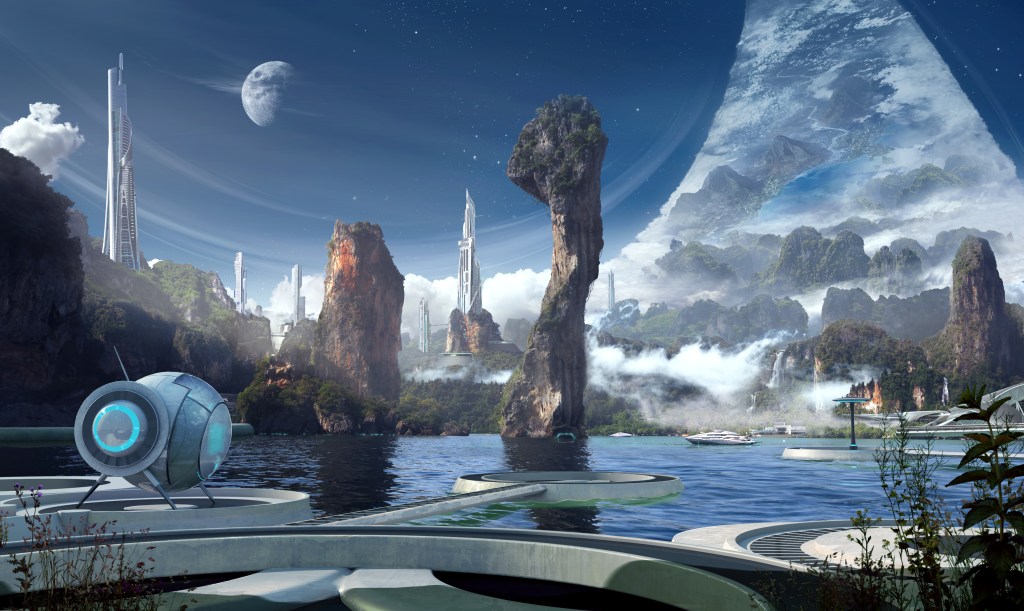
Halo. Avatar. Dune.
If you had to pick one thing that all three of these works of science fiction have in common, all different forms of media, it would be that they all have incredibly unique, well-realized settings. Would Halo have been nearly as enticing if it wasn’t set on a massive ring that encircled a sun? What would Dune have been without the planet Arrakis? Imagine a less realized version of Pandora in Avatar: Would it have been anywhere near as impressive without it?
Some of the best works of science fiction, regardless of medium, owe their excellence to their setting. Larry Niven, one of the greats of sci-fi, has multiple works that have their greatest strength in their setting. Ringworld and The Integral Trees, the latter of which is one of my favorite works of science fiction of all time, both feature absolutely out of this world settings. Ringworld, which helped inspire the Halo game series, is set on a massive artificially constructed ring that orbits a sun, using centrifugal force to simulate gravity and with plates that orbit at a slightly faster speed to give the interior surface a day night cycle. I read Ringworld probably twenty years ago and I have forgotten most of the plot, but I will never forget the ringworld itself.
The Integral Trees pictures a torus shaped gas cloud that orbits a neutron star. The central part of the cloud, known as The Smoke Ring, is dense enough to support life. There is no land, only massive dual-ended tress that are upwards of a hundred kilometers in length, giant tufts of foliage known as jungles, and huge globules of water known as ponds. Living at the ends of the titular integral trees are descendants of colonists, adapted for the almost zero g environment. The story itself is a fantastical journey by a small group of tribal inhabitants of one of the trees as they discover their origins and the larger society that inhabits the Smoke Ring.
In the film world I go back to James Cameron’s Avatar. Cameron handled the creation of Pandora with an artists hand guided by the best professional expertise he could hire. Not only did we know that Pandora was a moon of a gas giant name Polyphemus in the Alpha Centauri system, but Cameron went so far as to create an entire ecological system for the planet. It was vital to Cameron that everything on Pandora made sense in regards to the planet itself. Plants and animals were larger to make up for the lower gravity of Pandora. The animals were mostly hexapodal so they could get a better grip in the same, lower gravity and to support the bulk of their larger size. The bioluminescence that is seen throughout Pandora was a result of the ability of the wildlife to all connect to the natural “network” of Pandora. This is just a fraction of what they went through when creating Pandora’s ecosystem, and that is without including the Na’vi and their language and culture. At the end of the day, when people think about Avatar, what they remember is the planet Pandora.
Due to the time constraints that movie’s have it is rare that we really get to see a lot of truly well thought out settings like in Avatar. Christopher Nolan’s Interstellar, which in my personal opinion was a fairly lackluster film, did excel when it came to setting. The two worlds they visit are both wildly vivid and memorable. From the massive tidal waves of Edmund’s planet to the frozen clouds of Mann’s planet, Nolan gave us some truly amazing visuals without spending a ton of time on either. Nolan wanted to show his audience wildly alien planets without investing the entire movie’s runtime in the world building and in that regard he succeeded admirably. It’s a shame that he fumbled the ending so badly though; Interstellar could’ve been a landmark hard science fiction film.
With film the audience gets to see the worlds that the characters inhabit and with literature the author can take the time they need to build the world as much as they want. However, only one medium can truly do both of those at the same time and that is gaming. While we already mentioned Halo and how important that setting was to the game’s image, there are a few games that handle their unique settings with absolute excellence.
If you think back to the early 2000’s and the failed (yet amazing) system that was the Sega Dreamcast, there is always one title that comes to mind for most people and that is Skies of Arcadia. The world of Arcadia is not only enormous but incredibly imaginative. The entire population of Arcadia live on floating rocks above the clouds that range from the size of house to the size of a continent. Beneath the clouds the pressure is too extreme to support life and different regions of Arcadia are separated by massive storms. Travel on Arcadia is all done by airship and the entire world is built around this premise. For the most part, the core game was nothing groundbreaking; the combat was relatively standard for RPG’s at that time, the exception being the really cool ship to ship combat, and airships are a fairly standard trope in most RPGS. Where the game shined was in the exploration of Arcadia. There was always something new to discover around every corner of the world and as you made discoveries you would learn more and more about the strange world that was Arcadia.
More recently, on the Nintendo Switch is the game Xenoblade Chronicles 2. Now the Xeno-series has always had some awesome settings, including the nameless world in Xenogears, the massive starships and space stations in the Xenosaga trilogy, and the massive frozen corpses of gods that made up the setting of the first Xenoblade Chronicles. The world of Alrest in Xenoblade Chronicles 2 is similar to that of Skies of Arcadia in that it is covered in clouds. Where it differs is the land mass; the living area for the residents of the Xenoblade Chronicles 2 is all on the backs of massive lifeforms known as Titans. And being living creatures, these Titan move around. Sometimes they would be deeper into the clouds and other times they would be further out of the clouds, opening up different exploration opportunities depending on the depth of the clouds. This dynamic of society living on the back of these titans, which are at the tale end of their life cycle and nearing extinction, truly draws the player in.
Now we get to the importance of setting. All of the settings listed are paramount for the stories. As I said in the beginning, Avatar on any other world than Pandora is just an average film. The realization of Pandora is what elevates it to the classic that it will be remembered as. The common denominator for all these examples is that the creators took the time to create their setting. As an author, if I don’t take the time to flesh out the world that my characters exist in, then my characters will never be able to reach their fullest potential. If you are writing, take a few moments to really look at your setting and ask yourself, “what does it bring to the story?” Treat your setting with the same love and care that you do your characters and it will essentially become a character of its own. Do research. If you can’t do the research yourself, network with someone who can. Don’t let your settings just be a place in your plot but rather have your setting enhance your plot.
There are countless examples of great sci-fi setting across the mediums. Even in the music world we have Coheed and Cambria with their first six albums set in a fictional universe called Heaven’s Fence. A good setting can make the difference between an average work and a timeless classic. In my opinion, the ones that I shared are amongst some of the best setting in all of science fiction but are only a fraction of the amazing worlds out there. I hope that I can produce a setting even half as memorable as the ones I’ve shared!
What are some of your favorite sci-fi settings? Share in the comments!


 Patrick D Quinn
Leave a comment